
AI agents promise to automate everything from customer enquiries to updating business systems. But who's controlling what those agents are allowed to do?
For years, businesses have invested in controlling their software. We have user permissions, change management, source control, approval processes, audit logs and security policies.
Now consider what happens when an employee connects ChatGPT to the company's systems and asks it to start doing work.
Suddenly, software that once required developers, testing and controlled releases can be replaced by instructions written in plain English.
That's enormously powerful. But it raises an uncomfortable question.
Are we giving AI agents more freedom than we'd ever give conventional software?
The problem with personal AI automation
Imagine a business where five employees use AI to help process customer orders.
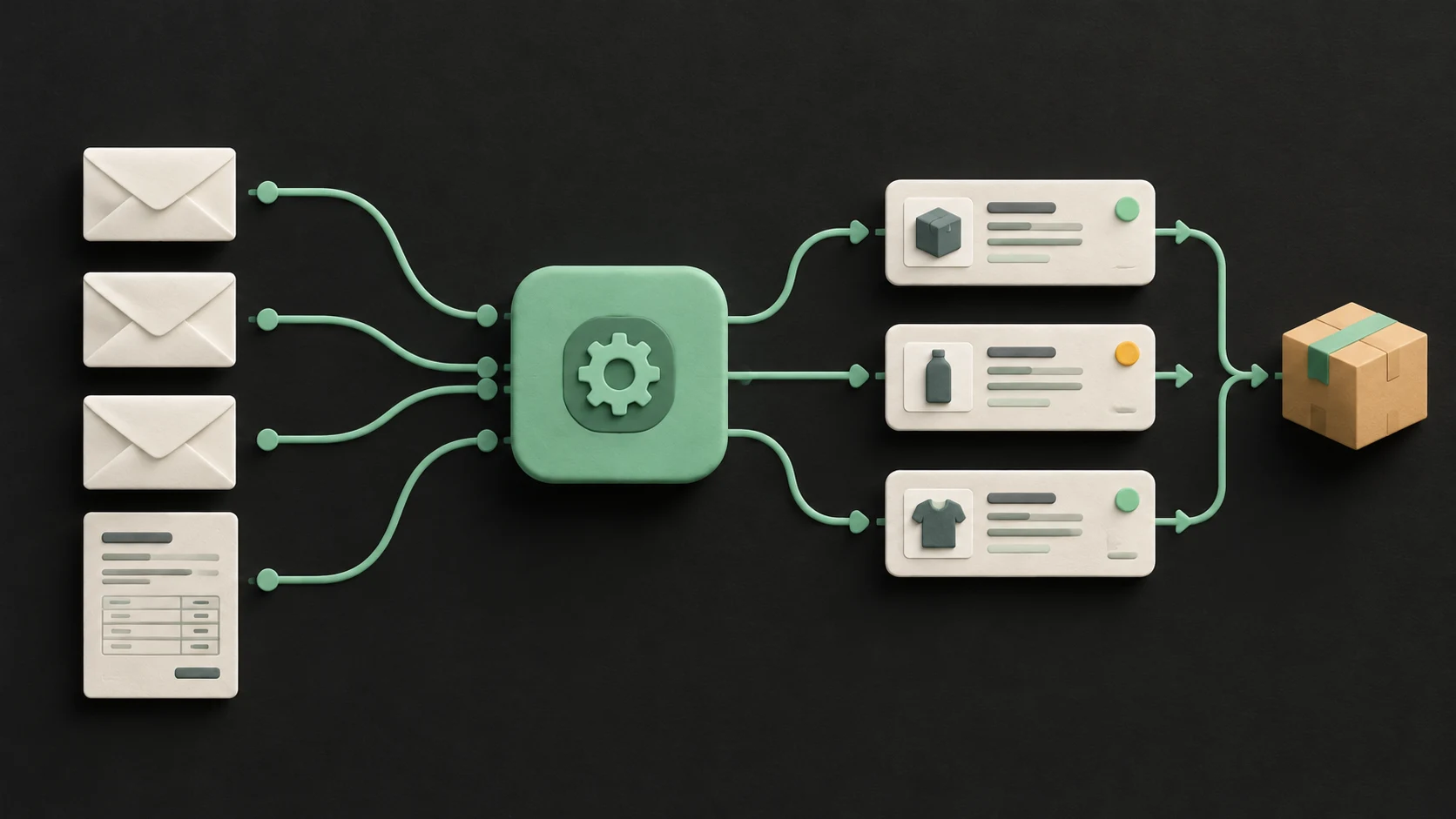
One employee creates a workflow that reads incoming order emails, extracts product details and quantities, and routes draft orders into the company's order management system.
It works brilliantly.
A colleague copies it and modifies the instructions. Another creates their own version. Someone else continues using an older version that doesn't include a recently introduced approval step.
Before long, the business has several independently evolving automations, all interacting with the same systems.
Nobody deliberately created a security problem. Everyone was simply trying to work more efficiently.
But which workflow represents the company's approved process?
Who authorised the changes?
And what prevents someone from accidentally bypassing a critical business control?
This is a new variation of an old problem: shadow IT. Except now the independently created software can take actions, update records and potentially make business decisions.
We might call it shadow automation.
Why version-controlled prompts aren't enough
Software developers have long relied on source control systems such as Git to manage changes.
The same principles should apply to AI workflow instructions. We should know which version is approved, who changed it, what was tested and how to roll back.
But version control only solves part of the problem.
Even if a company stores its approved AI instructions in GitHub, what prevents someone from creating a different version in their own ChatGPT account?
Or asking another AI platform to perform the same task?
The real issue isn't just controlling the instructions.
It's controlling what those instructions are allowed to make happen.
The missing layer: an AI workflow firewall
A traditional network firewall controls which systems can communicate.
An AI workflow firewall takes that principle further, controlling which actions an AI agent can perform inside business applications.
Consider an AI assistant that reads customer order emails and connects to the company's order management system.
It might be allowed to:
- Read customer records, product information and existing orders.
- Create draft orders from customer emails and attached purchase orders.
- Route orders to the right sales team or fulfilment queue.
- Flag missing information, unusual quantities or possible duplicate orders for review.
But confirming an order with a non-standard discount or changing agreed payment terms might require a sales manager's authorisation. Deleting order records could be prohibited entirely.
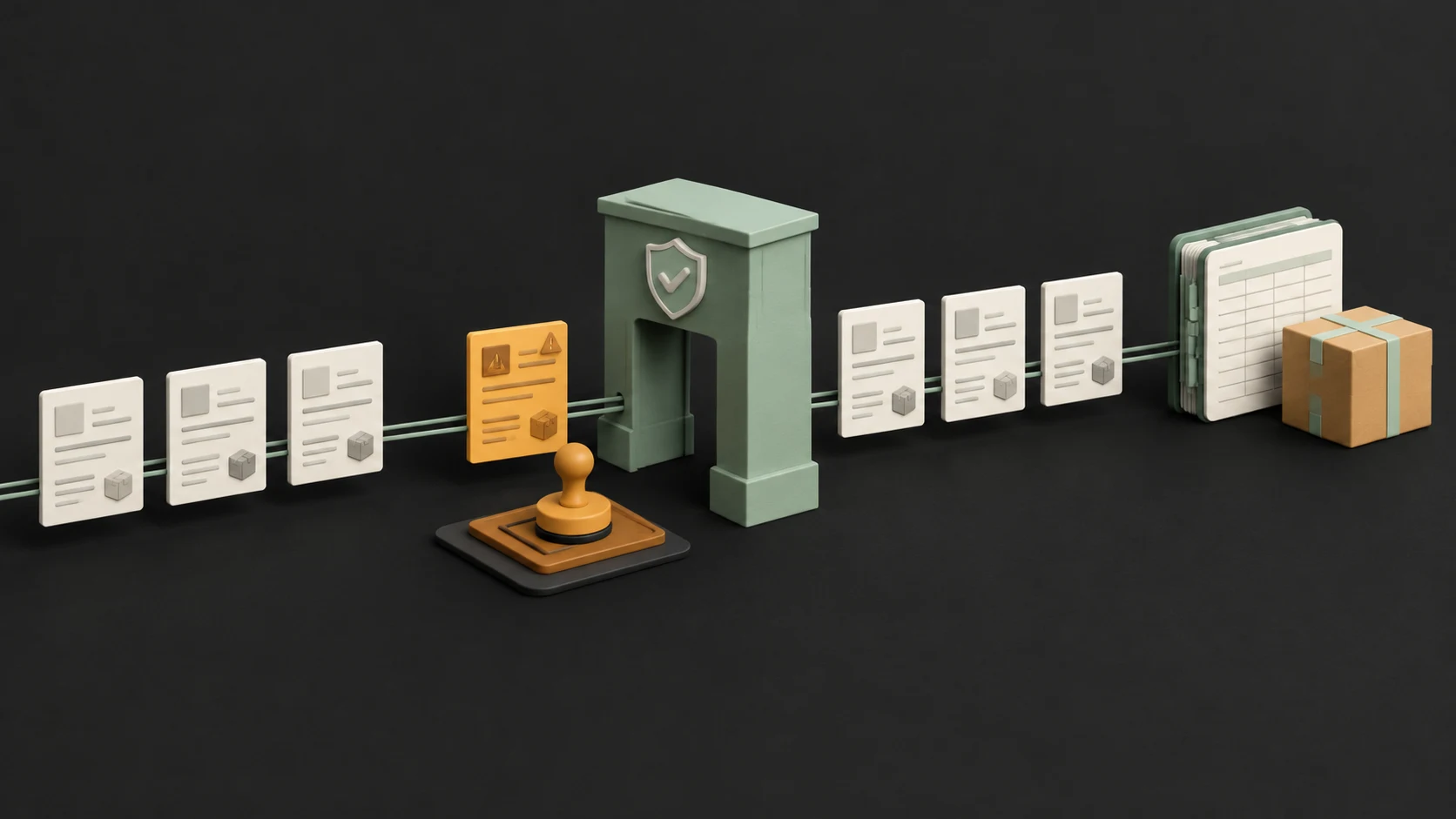
Rather than relying on the AI to remember these rules, a gateway evaluates each requested action before allowing it to reach the business system.
For example:
An AI agent requests permission to confirm an order with a discount outside the company's agreed limits.
The gateway verifies the user's identity, checks their order-processing permissions, examines the proposed discount and determines whether the necessary sales manager approval exists.
If it doesn't, the request is rejected and the order remains a draft for review.
Crucially, the rule is enforced outside the AI model.
It doesn't matter whether the request came from ChatGPT, another AI platform or a copied automation. The same business controls apply provided all write routes are governed.
MCP makes this particularly interesting
The Model Context Protocol, or MCP, is increasingly used to connect AI assistants with external applications and services.
It allows an AI assistant to discover and invoke tools exposed by business systems.
For example, an application might expose tools such as find_customer, create_draft_order and confirm_order.
That makes integration much easier, but a connection standard isn't the same as an organisational security policy.
An MCP gateway can sit between AI assistants and these services, applying authentication, permissions, approvals and auditing to individual tool calls.
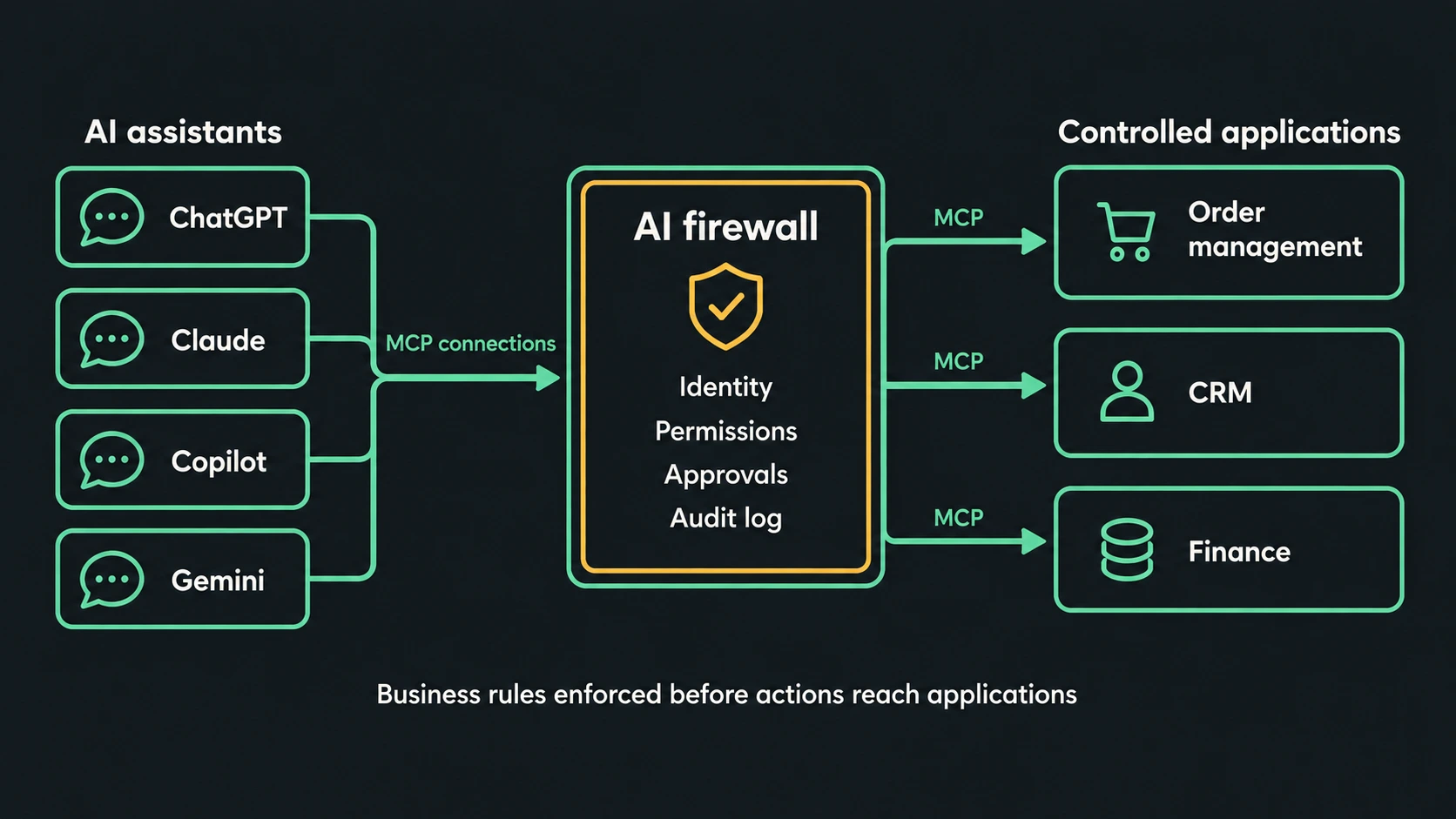
Products offering these capabilities are already emerging.
There's an important qualification, however: a gateway only protects the routes it governs. If an AI agent can access the same application through an unrestricted alternative API, the controls can potentially be bypassed.
Effective governance therefore requires security at the application level as well as at the AI integration layer.
Five controls every business should consider
Before giving AI agents permission to modify business systems, organisations should ask five questions.
1. Who owns the automation?
Is there a named owner responsible for its instructions, permissions and continued operation?
2. Which version is approved?
Can the organisation identify the authorised workflow, test changes before release and retire obsolete versions?
3. What is the agent allowed to do?
Are permissions limited to the actions and information genuinely required, or has the agent been granted unnecessarily broad access?
4. When is human approval required?
An AI assistant might create a draft customer response autonomously, but sending a contractual commitment or changing an agreed delivery scope could require explicit approval.
5. Can we establish what happened?
If something goes wrong, can the business identify the initiating user, the automation version, the requested action, the approval decision and the resulting system changes?
These aren't entirely new governance principles. They're established software engineering and operational controls applied to a new class of technology.
This shouldn't make AI adoption difficult
There's a danger of overcomplicating the answer.
Most small businesses don't need a dedicated AI security department or an elaborate enterprise governance platform.
They need proportionate controls.
A low-risk workflow that summarises correspondence can operate with considerable freedom. An automation that updates financial records, customer data or production applications deserves more scrutiny.
The objective isn't to stop people experimenting with AI.
It's to make sure the successful experiments can become dependable business processes without introducing unnecessary risk.
From clever automation to dependable operations
AI is making it easier than ever to build applications, integrate systems and automate work.
That's a genuine opportunity for smaller businesses, particularly those still dependent on spreadsheets, manual administration and disconnected software.
But successful adoption involves more than demonstrating that an AI agent can perform a task.
We also need to establish that it performs the right task, within the right permissions, using the approved process, with appropriate oversight.
The future of business AI isn't simply more autonomous agents. It's AI agents that organisations can safely depend upon.
At Feeed, we help businesses improve processes through practical software development, integration and automation, using AI where it adds genuine value.
As AI becomes more deeply connected to everyday business operations, we're exploring how to bring established software engineering disciplines — governance, testing, security and traceability — into this new environment.
Because making something work is only the beginning. Making it dependable is what makes it valuable.
Interested in improving your business processes with AI and automation? Talk to Feeed about practical opportunities to connect your systems, reduce manual work and introduce automation with appropriate controls.